Ozone water treatment in semiconductor manufacturing is the industry standard for eradicating biological growth, oxidizing organic contaminants, and maintaining the flawless integrity of Ultrapure Water (UPW) systems. If you manage a semiconductor fabrication plant, you already know that even a microscopic particle or a slight spike in Total Organic Carbon (TOC) can ruin an entire batch of expensive silicon wafers. By injecting dissolved ozone into your water lines, you provide an immediate, chemical-free defense against costly contamination.
The immediate value of utilizing ozone for water treatment lies in its incredibly high oxidation potential and its ability to leave zero harmful residues behind. Unlike traditional industrial sanitizers like chlorine or harsh chemical baths, ozone naturally breaks down into pure, breathable oxygen. This dramatically lowers chemical procurement costs and ensures strict compliance with environmental wastewater discharge limits.
By reading this comprehensive guide, you will gain a clear roadmap on how to implement dissolved ozone in your facility. We will break down how an industrial ozone generator operates, explore real-world wafer cleaning applications, and share a step-by-step framework to maximize your production yield while minimizing facility downtime.
What is Ozone Water Treatment in Semiconductor Fabs?
To understand why modern microelectronics facilities are abandoning legacy chemical treatments, we must first look at the science of ozone (O3). Ozone is an unstable gas composed of three oxygen atoms, making it one of the most powerful commercially available oxidants. When dissolved into water, it actively seeks out and destroys organic molecules, bacteria, and trace metals.
In semiconductor manufacturing, water purity is an absolute necessity. Facilities require millions of gallons of Ultrapure Water (UPW) daily to rinse silicon wafers between hundreds of complex photolithography, etching, and deposition steps. If the UPW loop becomes contaminated with biofilm, the entire multi-billion-dollar production line is put at risk.
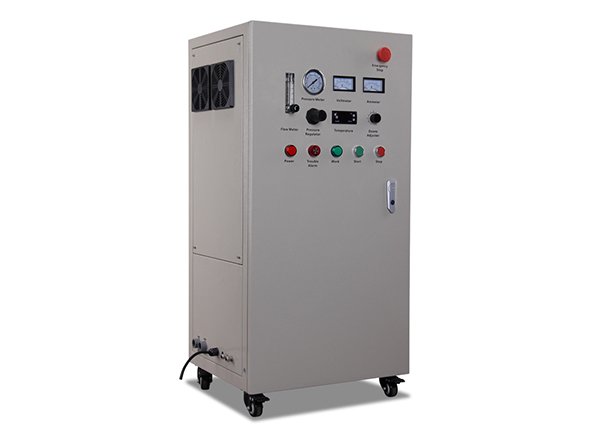
Integrating an industrial ozone generator directly into the UPW distribution loop creates a continuous, automated sanitization process. The generator pulls in high-purity oxygen, applies an electrical charge to split the molecules, and forms ozone gas. This gas is then safely injected into the water stream using specialized mass transfer systems, guaranteeing rapid and complete sterilization of the cleanroom’s water supply.
Key Benefits of Using Ozone for Water Treatment in Microelectronics
Switching to ozonated water offers cascading benefits that improve both the bottom line and the environmental footprint of a semiconductor fab. Below are the primary advantages driving the industry-wide adoption of this technology.
Unmatched Total Organic Carbon (TOC) Reduction
TOC is the enemy of semiconductor yield, as organic residues interfere with the adhesion of microscopic circuit layers. Ozone reacts instantly with organic compounds, fracturing their molecular bonds and converting them into harmless carbon dioxide and water. This highly efficient oxidation process drops TOC levels down to single-digit parts-per-trillion (ppt).
Complete Biofilm Eradication in UPW Loops
UPW systems operate continuously, and their vast network of piping is highly susceptible to biofilm formation. Biofilms are notoriously resilient layers of bacteria that chemical treatments often fail to penetrate. Ozonated water aggressively attacks the extracellular matrix of biofilms, completely destroying the colony and preventing future microbial growth.
Elimination of Harsh Cleaning Chemicals
Historically, fabs relied heavily on sulfuric acid and hydrogen peroxide mixtures (SPM) for wafer surface preparation. Utilizing high-concentration ozonated water significantly reduces, and in some cases entirely replaces, the need for these hazardous chemicals. This dramatically lowers the costs associated with chemical purchasing, storage, handling, and toxic waste disposal.
Zero Chemical Residue
Because ozone is simply an activated form of oxygen, its natural half-life in water is quite short. Once it has done its job of oxidizing contaminants, it reverts entirely back to diatomic oxygen (O2). This leaves absolutely no chemical residue on sensitive silicon wafers, preventing unwanted chemical reactions during subsequent fabrication steps.
Understanding the Technology: How an Ozone Generator Fits In
Not all ozone systems are created equal, and semiconductor facilities require specialized, ultra-high-purity equipment. There are generally two methods of generating ozone, but only one is perfectly suited for the stringent demands of microelectronics.
Corona Discharge Generation
This traditional method passes dried air or oxygen through a high-voltage electrical field, simulating a lightning strike to create ozone. While cost-effective for municipal water treatment, it can introduce trace amounts of nitrogen oxides or particulate matter. Therefore, it is typically limited to pre-treatment stages in semiconductor wastewater management rather than pure UPW loops.
Electrolytic Ozone Generation (The Gold Standard)
For critical cleanroom applications, fabs utilize electrolytic ozone generation. This process creates ozone directly from the ultrapure water itself by applying an electric current across a synthetic diamond or specialized anode. Because it requires no external feed gas, there is zero risk of introducing ionic contaminants or airborne impurities into the pristine water supply.
Mass Transfer and Injection Systems
Once generated, the ozone must be seamlessly dissolved into the flowing water stream. Fabs use highly engineered Venturi injectors or specialized gas-permeable membrane contactors to ensure maximum dissolution efficiency. This guarantees precise dosing, allowing operators to maintain the exact parts-per-million (ppm) concentration required for their specific wafer cleaning protocols.
Step-by-Step: Implementing Ozonated Water in Semiconductor Processes
Upgrading a facility’s UPW system requires careful engineering and precise process control. Here is a typical, step-by-step framework for integrating ozone into a high-volume semiconductor fab.
Step 1: Baseline Water Analysis and Sizing
Before installing any new equipment, engineers must conduct a thorough audit of the facility’s current TOC levels, flow rates, and microbial counts. This data is critical for sizing the generator accurately. An undersized system will fail to eradicate biofilm, while an oversized system wastes valuable energy and capital.
Step 2: Selecting the Injection Point
The placement of the ozone injection system determines its effectiveness. Most modern fabs inject ozone immediately after the primary reverse osmosis (RO) membranes or directly into the UPW storage tanks. This placement ensures that the entire distribution loop remains continuously sanitized before the water reaches the production floor.
Step 3: Managing Contact Time and Distribution
Ozone requires sufficient contact time with the water to achieve complete oxidation of complex organic molecules. Engineers design the storage tanks and piping to guarantee the water remains ozonated for at least 5 to 15 minutes. The water is then circulated continuously through the facility to prevent any stagnant “dead legs” where bacteria could hide.
Step 4: Point-of-Use (POU) Destruction
While ozone is excellent for pipe sanitization, it must often be removed right before the water touches certain sensitive microchips to prevent unwanted surface oxidation. Facilities install specialized 254nm Ultraviolet (UV) light destruct units right before the point of use. The intense UV light instantly shatters the ozone molecules, returning the water to its pure, un-ozonated state.
Real-World Applications: Silicon Wafer Cleaning and Surface Prep
Beyond simple pipe sanitization, advanced microelectronics facilities are using ozonated water directly in the manufacturing process. It has become a foundational tool in front-end-of-line (FEOL) semiconductor manufacturing.
Replacing the Standard RCA Clean
For decades, the industry standard for cleaning silicon wafers was the “RCA clean,” a complex, multi-step process utilizing massive amounts of hazardous chemicals. Today, engineers replace several of these steps with highly concentrated ozonated water. It effectively removes organic photoresist residues and metallic trace contaminants with superior efficiency.
Creating Pristine Oxide Layers
During surface preparation, wafers often require a thin, perfectly uniform passivation layer of silicon dioxide. Spraying wafers with highly concentrated dissolved ozone at room temperature grows a high-quality, ultra-thin oxide layer automatically. This eliminates the need for high-temperature thermal oxidation furnaces, saving massive amounts of electricity and production time.
Photoresist Stripping
After photolithography, the hardened photoresist polymer must be completely stripped away without damaging the delicate circuitry beneath. Wet-ozone processes combine ozonated water with mild heat or trace amounts of hydrofluoric acid to rapidly dissolve the stubborn polymers. This approach is highly effective, safer for operators, and significantly reduces toxic chemical runoff.
Hypothetical Case Study: NextGen Microelectronics Boosts Yield by 14%
To illustrate the financial impact of this technology, let’s look at a hypothetical scenario involving “NextGen Microelectronics,” a high-volume semiconductor fab producing advanced 5nm chips. NextGen was struggling with recurring biofilm blooms in their 20,000-foot UPW distribution loop, resulting in a 6% batch failure rate due to microscopic defects.
They were spending over $1.2 million annually on chemical sanitizers and experiencing 48 hours of complete facility downtime every month to flush the massive pipe network. Seeking a permanent fix, NextGen installed a fully automated, electrolytic ozone water treatment system directly into their main UPW storage array. They configured the system to maintain a constant 0.05 ppm ozone residual throughout the distribution loop.
The Transformative Results
Within the first 30 days, NextGen’s water quality sensors recorded a staggering 90% drop in TOC levels, plummeting to below 1 ppt. The constant presence of dissolved ozone systematically starved and eradicated the existing biofilm without requiring a single hour of facility downtime. Over the course of the year, NextGen increased their overall chip yield by 14% and entirely eliminated their $1.2 million chemical sanitization budget.
Overcoming Common Implementation Challenges
While the benefits are immense, integrating highly reactive gases into a cleanroom environment does come with engineering hurdles. Facility managers must proactively address these challenges to ensure a safe and reliable operation.
Material Compatibility and Degradation
Because ozone is such a powerful oxidant, it rapidly degrades standard plastics, rubber seals, and inferior metals. To prevent leaks and system failures, all piping, gaskets, and wetted components in an ozonated UPW loop must be constructed from high-grade 316L stainless steel. If plastics are required, only specialized fluoropolymers like PTFE or PFA should be utilized.
Managing Off-Gassing and Safety
Not all injected ozone dissolves perfectly into the water; some of it escapes as a free gas inside the storage tanks. Because high concentrations of airborne ozone are hazardous to human health, tanks must be equipped with specialized venting systems. These vents direct the excess gas through a thermal-catalytic destruct unit, safely converting it back to breathable oxygen before releasing it into the atmosphere.
Maintaining Consistent Dissolved Levels
Semiconductor processes require absolute consistency, but ozone naturally degrades over time, especially in warm water. Engineers must install highly sensitive dissolved ozone monitors at multiple checkpoints throughout the distribution loop. These sensors integrate directly into the facility’s SCADA system, automatically adjusting generator output to maintain perfect ppm concentrations regardless of fluctuating water temperatures.
Frequently Asked Questions (FAQ)
What is the purpose of ozone in ultrapure water systems?
The primary purpose is to continuously sanitize the water distribution network without adding permanent chemicals. Ozone actively kills bacteria, destroys biofilm, and oxidizes total organic carbon (TOC) into carbon dioxide. This ensures the water remains incredibly pure, preventing microscopic defects during silicon wafer manufacturing.
How long does dissolved ozone last in semiconductor water lines?
The half-life of dissolved ozone in ultrapure water at room temperature is typically between 15 to 30 minutes. Its exact lifespan depends on the water temperature, the flow rate, and the amount of organic material present in the system. Because it decays so quickly, generators must continuously inject ozone to maintain an active residual concentration.
Is ozone safe for direct contact with silicon wafers?
Yes, and it is frequently used deliberately in advanced wafer cleaning processes. However, because it is an aggressive oxidant, it can grow unintended thin oxide layers on bare silicon. If a specific manufacturing step requires completely un-oxidized water, facilities easily remove the ozone using a UV destruct light just before the water hits the wafer.
Can an ozone generator replace UV water treatment entirely?
While highly effective, ozone rarely replaces UV systems entirely in semiconductor fabs; rather, they work together as a dual-defense mechanism. Ozone provides continuous, residual sanitation throughout miles of piping where UV light cannot reach. UV systems are then utilized at the final point-of-use to instantly destroy the ozone and provide one last blast of sterilization.
Conclusion and Next Steps
Implementing ozone water treatment in semiconductor manufacturing is no longer just a technological luxury; it is an operational necessity for modern fabs. By eradicating biofilm, drastically lowering TOC, and replacing harsh chemicals, facilities can produce more advanced microchips with vastly superior yield rates. The transition to ozone improves your bottom line, ensures strict environmental compliance, and future-proofs your ultrapure water systems.
The upfront engineering required to properly size an ozone generator, select compatible piping materials, and fine-tune your mass transfer systems will pay dividends for decades. If you are still relying on continuous thermal sanitization or hazardous chemical injections, you are leaving substantial operational savings on the table.
Are you ready to optimize your cleanroom water systems?
Contact our team of ultrapure water engineers today for a comprehensive facility audit. We will help you design, install, and optimize a customized ozone system that completely eliminates your biofilm challenges and maximizes your manufacturing yield.