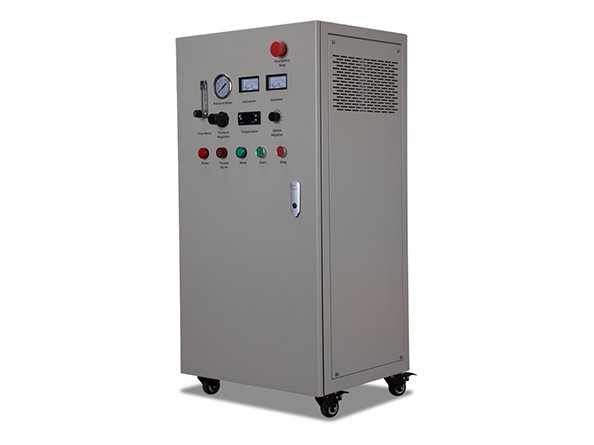
An ozone destructor is a safety device designed to convert residual ozone (O3) gas back into stable oxygen (O2) before it is vented into the atmosphere. It is needed because ozone is a potent oxidant and respiratory irritant; discharging it untreated poses significant health risks to personnel and can cause rapid degradation of surrounding industrial equipment and materials.
Introduction: The Hidden Risk of Industrial Ozone
Ozone is one of the most powerful disinfectants and oxidizing agents available today. From municipal water purification to high-tech semiconductor cleaning, its ability to destroy pathogens is unmatched. However, this power comes with a significant catch: ozone is inherently unstable and toxic at ground level.
If you are using an ozone generator for water treatment, you are likely producing more ozone than the water can actually absorb. This excess gas, known as “off-gas,” cannot simply be released into the room or the environment.
In this guide, we will break down the mechanics of ozone destruction, the different types of destructors available, and the regulatory reasons why skipping this component is not an option for any professional operation.
—
What Exactly Is an Ozone Destructor?
At its core, an ozone destructor is a reaction chamber. Its sole purpose is to accelerate the natural decay of ozone back into breathable oxygen. While ozone eventually breaks down on its own, this process takes too long in an industrial setting where gas is constantly being produced.
The destructor acts as a “tailpipe” for your ozone system. It captures the off-gas from a contact tank or reaction vessel and subjects it to a catalyst or heat, breaking the weak chemical bond of the third oxygen atom instantaneously.
How It Fits Into the System
In a standard setup, the process looks like this:
• Oxygen Feed: Pure oxygen or dry air enters the generator.
• Generation: The ozone generator for water treatment creates O3.
• Mass Transfer: Ozone is injected into the water.
• Off-Gassing: Excess ozone rises to the top of the tank.
• Destruction: The Ozone Destructor neutralizes the gas before it exits the vent.
—
Why Is an Ozone Destructor Necessary? (The 3 Pillars)
1. Personnel Safety and Health
Ozone is classified by OSHA and the EPA as a hazardous gas. Even at low concentrations (above 0.1 ppm), it can cause chest pain, coughing, throat irritation, and shortness of breath. Long-term exposure can lead to chronic lung diseases like asthma or permanent scarring of lung tissue.
2. Environmental Compliance
Regulatory bodies strictly limit the amount of ozone that can be exhausted into the ambient air. Without a high-efficiency destructor, your facility risks heavy fines and “stop-work” orders from environmental protection agencies.
3. Equipment Longevity
Ozone is highly corrosive. If “raw” ozone is vented into a mechanical room, it will rapidly oxidize rubber seals, gaskets, copper wiring, and electronic components. An Ozone Destructor protects your capital investment by ensuring the air in your facility remains non-corrosive.
—
Types of Ozone Destructors
Not all destruction methods are equal. Depending on your flow rate and ozone concentration, you will typically choose between two main technologies.
Catalytic Ozone Destructors
This is the most common type used in commercial applications. It utilizes a catalyst material—typically manganese dioxide or copper oxide—to break down the O3 molecule.
• Pros: Energy-efficient (requires little to no power), long lifespan if kept dry.
• Cons: Highly sensitive to moisture. If water vapor enters the catalyst bed, it “poisons” the material, rendering it ineffective.
Thermal Ozone Destructors
Thermal units use high heat (typically 300°F to 350°F) to force the ozone molecules to vibrate and break apart.
• Pros: Not affected by moisture or “poisoning” from contaminants.
• Cons: High energy consumption and requires a cooling phase for the exhaust air.
Pro-Tip: If your application involves high humidity—such as wastewater treatment—always install a “moisture trap” or a pre-heater before a catalytic Ozone Destructor to prevent catalyst failure.
—
The Role of Ozone Destruction in Water Treatment
When using an ozone generator for water treatment, the efficiency of gas-to-liquid transfer is rarely 100%. Usually, 10% to 20% of the generated ozone remains as a gas.
In large-scale municipal plants or commercial bottling lines, this translates to a massive amount of toxic gas. The destructor ensures that the water is purified effectively without creating an atmospheric hazard. It bridges the gap between high-performance oxidation and operational safety.
—
Key Components of a High-Quality Destructor
To ensure your system ranks as “high-authority” in terms of safety, look for these features:
• Stainless Steel Housing: To resist the corrosive nature of the gas before it is destroyed.
• Heating Elements: Even in catalytic models, a small heater is often used to keep the catalyst bed above the dew point.
• Replaceable Media: The ability to swap out catalyst pellets without replacing the entire unit.
• Check Valves: To prevent water from backing up into the destructor from the contact tank.
—
Maintenance and Monitoring: Ensuring EEAT (Expertise)
As an expert strategist in industrial gas systems, I cannot overstress the importance of Ozone Monitoring. A destructor is a passive device; you won’t know it has failed unless you are measuring the output.
• Ambient Monitors: Install sensors near the destructor exhaust to trigger an alarm if levels exceed 0.05 ppm.
• Annual Catalyst Testing: Catalytic media loses surface area over time. Plan for a media replacement every 12-24 months depending on usage.
• Airflow Checks: Ensure the vacuum or pressure driving the gas through the destructor is consistent.
—
FAQs: Everything You Need to Know
1. How long does an ozone destructor catalyst last?
Typically, a catalyst bed lasts between 1 to 2 years. However, if it is protected from moisture and dust, it can last longer. If “poisoned” by water, it may need immediate replacement.
2. Can I vent ozone outside without a destructor?
In almost all jurisdictions, this is illegal and unsafe. Ozone is heavier than air and can settle in low-lying areas, creating “pockets” of toxic gas that endanger people and local wildlife.
3. Does a destructor require a lot of electricity?
Catalytic destructors require very little power—usually just enough for a small heater to prevent condensation. Thermal destructors, however, require significant wattage to maintain high internal temperatures.
4. What happens if water gets into the destructor?
Water is the “enemy” of the catalyst. It coats the active sites on the manganese dioxide, stopping the reaction. You must dry the media completely or replace it to restore functionality.
5. Are there different sizes of destructors?
Yes. Destructors are sized based on “SCFM” (Standard Cubic Feet per Minute). You must match the flow rate of your ozone generator for water treatment to the capacity of the destructor.
—
Conclusion: Safety is Non-Negotiable
An Ozone Destructor is not just an accessory; it is a critical safety component of any responsible ozone system. Whether you are running a small craft brewery or a massive municipal water plant, neutralizing off-gas is essential for protecting your staff, your equipment, and the environment.
By investing in high-quality destruction technology and maintaining it through regular catalyst checks, you ensure that your ozone system remains an asset rather than a liability.
Ready to upgrade your ozone safety protocol?
Contact our engineering team today to find the perfectly sized Ozone Destructor for your application and ensure your facility meets all OSHA and EPA safety standards.